What Is an AI-Integrated B.Tech Program and How Is It Different from a Regular B.Tech?
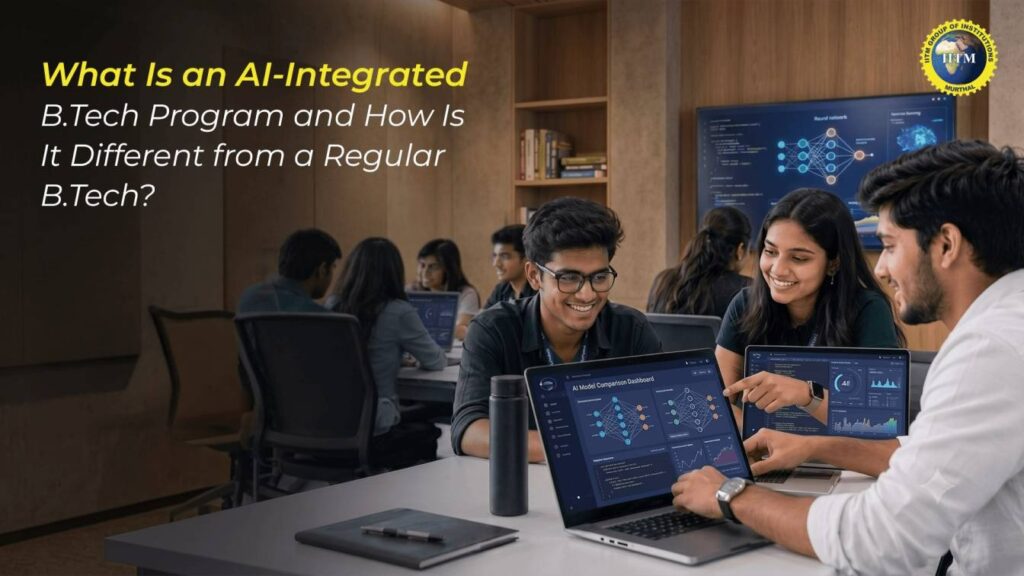
Walk into any engineering course today and the students would find that the conversations have shifted entirely. Circuits and syntax now share space with machine learning, data trends, and how machines “think.” This makes sit very clear that AI has moved from just as an optional elective to a core part of any industry relevant B.Tech program, and it’s reshaping how colleges across India teach, and how students prepare for real careers.
What Has Actually Changed Inside the BTech Curriculum?
A few years ago, AI belonged mostly to postgraduate research. Now, the pace of companies old and emerging adopting AI into its workflow is increasing steadily, leading the universities to rethink their entire approach. Engineers in 2026 and beyond are expected to understand technology and further build systems that learn, adapt, and make decisions. This shift is exactly what an AI-Integrated Btech Program is built for students by incorporating AI within the B.Tech coursework rather than just leaving it to a single advanced-semester subject.
At IITM Sonipat, it starts as early as the first year itself. Now initial-year courses in programming, mathematics, and statistics carry a bias toward AI applications. With concepts like linear algebra and probability getting introduced within the first year to build the foundation for understanding how algorithms learn from data.
How Does AI Show Up as Students Progress Through College?
As students progress through their second and third years, AI learning becomes more practical. Subjects like machine learning, data science, and deep learning are introduced that builds a student’s base in technologies that are behind recommendation systems, chatbots, and image recognition that they use every day.
Learning also becomes more hands-on. Instead of focusing only on theory, students work on coding exercises, real datasets, and practical projects to understand how AI works in real-world scenarios. Hence, by the time they graduate, many have built projects such as predictive models, chatbots, or AI-powered applications, giving them valuable experience before entering the workforce.
Is AI Only Relevant for Computer Science Students?
Not anymore. AI integration has spread well beyond core CSE branches:
- Mechanical engineers use AI to design smarter machines and robotics systems.
- Civil engineers apply it to plan smart cities and monitor infrastructure.
- Electrical engineers use it in energy systems and smart grid management.
This interdisciplinary approach makes modern engineering education more relevant and future-focused. Instead of learning only their core subject, students also discover how AI and other emerging technologies can improve and transform their field.
What Does The B.Tech Program at IITM Institute Look Like?
IITM Institute, Sonipat’s B.Tech program which is powered by Sunstone, is a clear example of this model in practice. Its AI-Integrated B.Tech Program builds AI exposure, live projects, and industry certifications directly into the four-year journey, with Sunstone further adding to the course with structured placement preparations from the very first year.
| Program Detail | Information |
| Institution type | AICTE-approved, NAAC-accredited private institute |
| Established | 2010, Sonipat, Haryana |
| Coding practice | 2 hours daily, starting from semester one |
| Structured training | 550+ hours in coding and Data Structures & Algorithms |
| AI exposure | 2 new AI tools introduced every year |
| Internship | 6/9-month internship built into the programme |
| Interview preparation | 100+ hours, including mock interviews and technical evaluations |
| Recruiter access | 1,200+ hiring partners, 200+ job opportunities |
| Average package | ₹8.5 LPA |
| Eligibility | 45% aggregate in Class 12 with Physics and Mathematics compulsory (5% relaxation for SC/ST/OBC) |
Students choose from five specialization:
- Full Stack Web Development
- Data Science or Data Engineering
- Cyber Security
- AWS Cloud Computing
- Artificial Intelligence & Machine Learning
Plus, they also get the opportunity to work with tools spanning C/C++, Java, SQL, Git, React, Node.js, and cloud platforms like AWS and Azure. The curriculum itself is refreshed every six months based on direct industry input.
Why Are Ethics and Accountability Becoming Part of the Syllabus?
As AI takes on more influence, questions around fairness and responsibility are becoming unavoidable. Who’s accountable when an AI system gets something wrong? How do institutions ensure algorithms stay unbiased?
Unlike any regular program, IITM’s B.Tech program is gradually building a space for these conversations alongside technical training, so students understand not just how to build intelligent systems, but the responsibility that comes with them.
Why Are New Age Colleges in India Leaning Into Industry Collaboration?
To keep the curriculum relevant, new-age colleges in India are partnering closely with tech companies through guest lectures, internships, workshops, and certification programs. This connection gives students a realistic sense of what the workplace actually expects, and it’s a big part of why placement-linked training now starts as early as year one rather than being crammed into the final semester.
Final Thought
AI isn’t just changing what engineering students learn, it’s changing how they think, solve problems, and approach uncertainty. An AI-Integrated B.Tech Program like the one at IITM institute, Sonipat, gives students a head start on this shift, blending coding, AI exposure, and placement readiness from day one.
This is what new-age education looks like in practice, and it’s already reshaping Indian classrooms today.
Frequently Asked Questions
An AI-integrated program weaves machine learning, data science, and practical AI tools throughout all four years, rather than offering AI as one elective. Students build real projects alongside coding fundamentals from semester one onward.
No, AI now spans branches. Mechanical engineers use it for robotics, civil engineers apply it to smart infrastructure, and electrical engineers use it in smart grids, making AI knowledge valuable across nearly every engineering discipline today.
Students choose from Full Stack Web Development, Data Science or Data Engineering, Cyber Security, AWS Cloud Computing, and Artificial Intelligence & Machine Learning, supported by structured coding hours, internships, and interview preparation throughout the program.
As AI influences more decisions, questions of fairness and responsibility matter more. Programs increasingly teach students to consider bias, accountability, and social impact alongside technical skills, preparing them to build systems responsibly, not just functionally.
They combine industry certifications, structured coding practice, and mock interviews with strong recruiter networks. This year-round approach, rather than last-semester preparation, helps students walk into interviews with a demonstrable, practical skill set already built.

I am Dr. Sunil Nijhawan, Principal and Head of the Departments of Electrical Engineering and Electronics & Communication Engineering. With over 25 years of academic experience, I am committed to delivering quality technical education through innovation, research, and industry-oriented learning. My focus is on developing technically proficient, ethically responsible, and future-ready engineers by fostering academic excellence, practical exposure, and a culture of continuous learning.