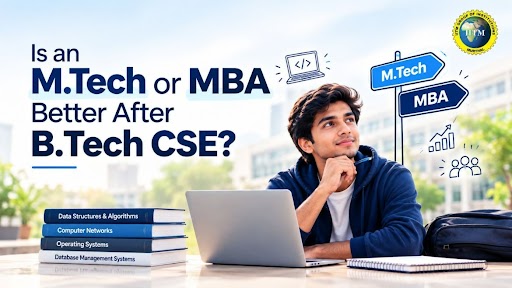
Is an M.Tech or MBA Better After B.Tech CSE?
Choosing a postgraduate degree after B.Tech CSE is an important academic and career decision. Some graduates want to deepen their technical knowledge, while others are interested in business, leadership, or management. M.Tech and MBA offer different learning experiences, so understanding their differences can help students make a choice that aligns with their interests and long-term plans.
For students exploring private engineering colleges in Haryana, the decision begins with building a strong undergraduate foundation. A quality B.Tech education can develop technical knowledge, practical skills, and problem-solving abilities that support different career pathways. Students considering engineering education in Haryana and Sonipat should therefore think about how their undergraduate preparation connects with their future academic and professional goals.
What Is M.Tech After B.Tech CSE?
Master of Technology, or M.Tech, is a postgraduate degree that focuses on advanced technical education. After completing B.Tech CSE, students can explore specialisations such as computer science, artificial intelligence, machine learning, data science, cybersecurity, and software systems, depending on the institution and available programs.
M.Tech typically involves advanced coursework, technical projects, analytical problem-solving, and research-oriented learning. It can be suitable for students who enjoy engineering subjects and want to develop deeper expertise in a specific area of technology.
An M.Tech may support career directions involving specialised engineering, software development, technical research, product development, or academic work. However, the opportunities available depend on the chosen specialisation, practical experience, technical skills, and employer requirements.
Students should review the curriculum carefully before applying. Understanding the subjects, projects, and specialisation options can help them determine whether the program matches their interests.
What Is MBA After B.Tech CSE?
Master of Business Administration, or MBA, is a postgraduate management degree that focuses on business operations, organisational decision-making, and management practices. While M.Tech emphasises technical specialisation, an MBA develops knowledge of how businesses operate and how strategic decisions are made.
MBA coursework may include finance, marketing, operations, human resources, business analytics, strategy, leadership, and business communication. The subjects covered depend on the institution and specialisation.
For B.Tech CSE graduates, an MBA can provide an opportunity to combine technical knowledge with business understanding. This combination may be relevant to technology products, business analysis, consulting, operations, or project management.
An MBA does not automatically qualify someone for senior management positions. Its relevance depends on the student’s specialisation, institution, curriculum, practical exposure, and career goals.
M.Tech vs MBA After B.Tech CSE: Key Differences
The two degrees differ primarily in their learning objectives and career focus. M.Tech is centred on advanced engineering knowledge, technical analysis, and specialisation. MBA focuses on business concepts, management practices, strategy, and organisational decision-making.
M.Tech may appeal to students who want to continue in a technical or research-oriented direction. MBA may appeal to students who want to explore business, leadership, or roles that connect technology with organisational needs.
The learning approach also differs. M.Tech students may spend more time on advanced technical subjects, engineering projects, and specialised problem-solving. MBA students may work on business cases, presentations, financial analysis, strategic decisions, and team-based assignments.
Neither degree is universally better after B.Tech CSE. The appropriate choice depends on what the student wants to learn and the type of career they want to build.
Which Career Pathways Can You Explore After M.Tech?
An M.Tech can support several technical and academic career directions. Depending on the specialisation, students may explore:
- Advanced technical engineering roles.
- Software and technology specialisation.
- Research-related work.
- Engineering and product development.
- Technical consulting.
- Teaching or academic pathways, where applicable.
For example, a student interested in artificial intelligence may pursue advanced study in machine learning or a related field. Someone interested in software systems may prefer subjects involving algorithms, distributed systems, or software architecture.
Career opportunities depend on more than a postgraduate qualification. Technical competence, projects, internships, communication, and employer-specific requirements can influence the roles available to graduates.
Which Career Pathways Can You Explore After MBA?
An MBA can help B.Tech CSE graduates develop business and management skills that complement their technical background. Depending on their specialisation and experience, students may explore:
- Product management.
- Business analysis.
- Technology consulting.
- Operations management.
- Marketing and business development.
- Strategy.
- Project management.
- Business analytics.
A technical background can be useful in technology-business roles because it may help professionals understand software products, communicate with technical teams, and interpret business requirements.
However, management education also requires business knowledge, communication skills, and an understanding of organisational processes. Students should compare MBA specialisations carefully because an MBA in business analytics, for example, may have a different focus from an MBA in marketing or finance.
How Your B.Tech CSE Background Influences the Decision
The foundation developed during B.Tech CSE can influence how students approach either postgraduate pathway. Before choosing M.Tech or MBA, it is useful to review the skills and experiences gained during undergraduate study.
These may include programming, data structures and algorithms, databases, software development, problem-solving, communication, teamwork, analytical thinking, and project experience.
Students who enjoy technical coursework may find advanced engineering study appealing. Those who enjoy coordinating projects, understanding business requirements, or working with teams may want to explore management education.
This is why job-ready B.Tech courses should be evaluated through their practical learning, project work, and skill development, rather than only their course titles. A strong undergraduate foundation can support different career directions, including technical specialisation and technology-business roles.
Why Industry-Relevant B.Tech Education Matters
A quality B.Tech education can prepare students for more than their first job or postgraduate application. It can help them understand how technical concepts are applied, how projects are developed, and how technology responds to real-world needs.
Important aspects to evaluate include:
- Practical projects and laboratory work.
- Internship opportunities and industry exposure.
- Emerging technology learning.
- Technical communication and teamwork.
- Problem-solving and analytical development.
- Career awareness and guidance.
An AI-Integrated B.Tech Program may introduce students to artificial intelligence through coursework, practical projects, tools, and applications across relevant subjects. However, AI integration should involve meaningful learning and skill development, not simply the use of AI as a promotional label.
Students should look for evidence of what they will actually learn, the projects they will complete, and how the curriculum supports their academic interests.
How to Choose an Engineering College in Haryana for Your Future Goals
When comparing private engineering colleges in Haryana, students should evaluate each institution in relation to their academic needs and future plans. The undergraduate college they choose can influence the learning environment, practical exposure, and opportunities they encounter during their degree.
Key factors to review include:
- Recognition and affiliation.
- Curriculum quality and subject coverage.
- Faculty and academic support.
- Laboratories and infrastructure.
- Practical learning and project opportunities.
- Industry exposure and internships.
- Career guidance and professional development.
- Overall fees and value.
Students should also examine whether the institution offers the technical subjects or specialisations they are interested in. For example, someone considering advanced computer science may want to understand the depth of programming, software development, and emerging technology education available during a B.Tech.
The goal is to select an institution that supports the student’s learning and future academic choices, rather than choosing based only on a course name or a single advertised feature.
Why IITM Sonipat Is Relevant to Your Engineering Education Journey
At IITM Sonipat, students can explore engineering education through B.Tech programs in areas such as Computer Science and Engineering, Artificial Intelligence and Machine Learning, Data Science, Mechanical Engineering, and Civil Engineering. The institution’s official website provides information about its academic offerings, curriculum, admission process, and campus facilities.
For students interested in computer science, the undergraduate learning journey can help establish a foundation in programming, computing concepts, analytical thinking, and technical problem-solving. These areas are relevant whether a graduate later chooses advanced technical education or wants to develop business and management skills through an MBA.
IITM Sonipat’s engineering education approach also emphasises practical learning and exposure to emerging technologies. Students should examine the specific curriculum, laboratory facilities, project opportunities, and academic support available for their chosen program.
For students researching private engineering colleges in Haryana, evaluating these factors can help them understand how an undergraduate institution may support their future academic and career decisions. The choice of B.Tech college should reflect the student’s learning preferences, financial considerations, and long-term plans.
How to Decide Between M.Tech and MBA
The decision becomes easier when students connect their academic interests with the kind of work they want to pursue.
M.Tech may suit students who:
- Enjoy technical subjects and engineering concepts.
- Want deeper knowledge in a specific technology field.
- Are interested in research or advanced technical problem-solving.
- Prefer a technology-focused academic pathway.
- Want to continue developing specialised engineering skills.
MBA may suit students who:
- Are interested in business and management.
- Want to develop leadership and decision-making skills.
- Enjoy strategy, operations, or business analysis.
- Want to explore technology-business roles.
- Are interested in management specialisations.
Students should also consider whether they want to enter postgraduate education immediately or gain work experience first. Work experience is not universally required for every MBA, but it can help students understand their professional interests and assess which management subjects are most relevant to them.
Financial considerations matter, too. Compare tuition fees, living expenses, available scholarships, and the time required to complete the degree. A postgraduate decision should be based on realistic planning rather than assumptions about guaranteed salaries or employment.
What to Consider Before Choosing Your Next Step
Before selecting an M.Tech or MBA, students can use the following checklist:
- Identify your career interests and preferred work environment.
- Compare the curriculum of relevant postgraduate programs.
- Evaluate technical learning versus management education.
- Review specialisation options.
- Consider practical and project-based learning.
- Examine internship and industry exposure opportunities.
- Understand eligibility and admission requirements.
- Compare fees and overall value.
- Consider your long-term career plans.
- Speak with academic or career advisors where appropriate.
Students planning their undergraduate education should also consider how a new-age B.Tech with an affordable price approach fits into their financial plans and learning expectations. Affordability should be assessed alongside curriculum quality, facilities, practical exposure, and the overall educational experience.
M.Tech or MBA After B.Tech CSE: Choose Based on Your Career Goals
M.Tech and MBA offer different career pathways, with M.Tech focusing on technical expertise and MBA on business management. The right choice depends on your interests, strengths, career goals, and finances. A strong undergraduate foundation, such as the one developed at IITM Sonipat, can help students make informed postgraduate decisions.
FAQs
An AI-integrated B.Tech program combines core engineering subjects with artificial intelligence coursework, practical projects, and emerging technology applications. At IITM Sonipat, students can explore technical learning that supports future career development.
Job-ready B.Tech courses combine technical knowledge, practical projects, internships, and professional skills. Computer Science, Artificial Intelligence and Machine Learning, and Data Science can help students prepare for different career pathways.
For B.Tech admission in Sonipat, students should check eligibility requirements, entrance criteria, application procedures, and required documents. Applicants to IITM Sonipat should review the latest admission information for their chosen program.
A new-age B.tech With Affordable Price approach combines modern technology education, practical learning, and career-relevant skills with manageable costs. Students should compare fees, curriculum quality, facilities, and overall educational value.
Yes, B.Tech CSE graduates can pursue an MBA if they meet the eligibility requirements. An MBA can develop business, management, and leadership skills alongside their technical background.