
Government Job vs. Private Job After Engineering: Which Branch Is Better?
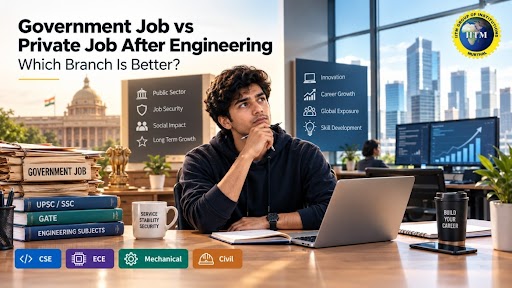
Choosing an engineering branch is often the first step toward a much larger career decision: whether to pursue a government job, build a career in the private sector, or keep both options open after graduation. For students exploring B.Tech colleges in Haryana, understanding how different engineering branches connect with these career paths can make the decision more informed.
Engineering graduates can explore opportunities in government departments, public-sector organisations, IT companies, manufacturing, infrastructure, electronics, consulting, research, and other industries. However, no single engineering branch guarantees a particular career outcome. The right choice depends on a student’s interests, skills, eligibility, career priorities, and willingness to develop relevant expertise.
Government Jobs After Engineering: What Does the Career Path Look Like?
Engineering graduates can explore several government-sector career pathways after completing their degree. Depending on the organisation and recruitment notification, opportunities may include technical positions, public-sector roles, engineering-related services, and other government positions that accept engineering qualifications.
Government recruitment can involve competitive examinations, technical assessments, interviews, or other selection stages. The eligibility requirements vary by organisation and position. Some roles may accept graduates from multiple engineering disciplines, while others may specify particular branches.
Students considering this pathway should therefore check the latest official recruitment notification before applying. Important details can include:
- Required engineering qualification
- Eligible engineering branches
- Age limit
- Examination pattern
- Required scores or qualifications
- Application dates
- Selection process
Government careers can require sustained preparation, particularly where competitive examinations are involved. Building strong engineering fundamentals, understanding the relevant examination syllabus, practising regularly, and maintaining a consistent preparation schedule can help students work toward applicable opportunities.
Private Jobs After Engineering: What Can Graduates Expect?
The private sector provides engineering graduates with opportunities across multiple industries and functions. Depending on their branch and additional skills, graduates can explore careers in:
- Software and IT
- Electronics and telecommunications
- Manufacturing
- Automotive
- Construction and infrastructure
- Data and technology
- Product development
- Consulting
- Operations
- Research and development
Private-sector hiring often considers more than an engineering degree. Employers may assess technical knowledge, practical projects, internships, problem-solving ability, communication skills, software proficiency, and adaptability.
For example, a computer science graduate may build skills in programming, cloud computing, cybersecurity, data, or artificial intelligence. A mechanical engineering graduate may develop expertise in CAD/CAM, manufacturing, automation, or robotics.
This makes continuous skill development important. Technology, tools, and employer requirements can change over time, so engineering graduates may need to keep learning even after entering the workforce.
Government Job vs Private Job After Engineering: Key Differences
The two sectors can differ in recruitment methods, career structures, work environments, and progression. The following comparison provides a general framework:
| Factor | Government Jobs | Private Jobs |
| Recruitment | Often involves formal recruitment processes and competitive examinations | Commonly involves applications, assessments, interviews, and skill-based selection |
| Eligibility | Depends on the specific recruitment notification | Depends on the company, role, qualification, and skill requirements |
| Salary Structure | Generally follows the applicable government pay structure | Can vary by company, industry, role, location, and experience |
| Career Progression | Often follows defined grades, service structures, and promotion systems | Can involve promotions, specialisation, role changes, or movement between organisations |
| Work Environment | Varies by department, organisation, and role | Varies by company, industry, team, and role |
| Mobility | Some positions can involve transfers or postings | Mobility depends on company policy, projects, and role requirements |
| Skill Development | Often centred on the requirements of the specific role | May require continuous adaptation to technologies, tools, and market needs |
| Selection Competition | Can involve highly competitive examinations | Competition generally varies according to the company and position |
Which Engineering Branches Offer Private-Sector Opportunities?
Each engineering discipline can lead to different private-sector career paths. Instead of ranking branches, students should consider the type of work, specialisation, industry exposure, and skills associated with each field.
| Engineering Branch | Potential Private-Sector Areas |
| CSE / IT | Software development, cloud computing, cybersecurity, data, AI, applications, technology services |
| ECE | Electronics, embedded systems, telecommunications, IoT, semiconductor-related areas, hardware-software integration |
| Mechanical | Manufacturing, automotive, product design, production, industrial engineering, automation, robotics |
| Civil | Construction, infrastructure, structural engineering, real estate, project management, transportation |
The breadth of opportunities within each field can vary based on location, industry conditions, individual skills, and additional qualifications.
Government vs Private Jobs: Which One Should Engineering Students Choose?
The choice depends on the student’s career priorities rather than on a universally superior option.
Students interested in government careers can consider factors such as:
- Interest in public-sector or government roles
- Willingness to prepare for competitive examinations
- Preference for structured recruitment processes
- Interest in specific technical or administrative positions
- Readiness to meet role-specific eligibility requirements
Students exploring private-sector careers can consider:
- Interest in corporate environments
- Preference for skill-based hiring
- Interest in technology or industry-specific roles
- Willingness to continuously develop technical skills
- Openness to changing roles or organisations
- Interest in private-sector specialisation
There is also no requirement to make the decision immediately after entering B.Tech. Students can build technical knowledge, complete projects, undertake internships, and explore different industries before deciding which pathway suits their goals.
What Should Students Look for in a B.Tech College?
Career preparation starts during the degree itself. Students comparing B.Tech colleges in Haryana should therefore evaluate more than just the name of an institution or advertised placement figures.
Key factors include:
- Curriculum: Check whether the curriculum provides strong engineering fundamentals and relevant contemporary subjects.
- Faculty: Consider faculty qualifications, teaching experience, and academic support.
- Laboratories: Practical facilities can help students apply concepts beyond classroom learning.
- Projects: Technical projects can help develop problem-solving and application-based skills.
- Internships: Industry exposure can provide an understanding of professional work environments.
- Industry interaction: Guest sessions, projects, mentorship, and industry exposure can broaden career awareness.
- Placement information: Review available placement information carefully and understand what the reported figures represent.
- Infrastructure: Consider laboratories, classrooms, libraries, computing facilities, and other learning resources.
- Location: Accessibility and proximity to employment and industrial hubs can influence internship and career exposure.
- Cost: Compare tuition, living expenses, transportation, and other costs before making a decision.
A college should ultimately be evaluated according to the student’s academic requirements, preferred engineering branch, career plans, and available resources.
Why Location Matters When Choosing an Engineering College
Location can influence a student’s access to educational resources, internships, industry exposure, transportation, and living arrangements. Sonipat’s position within the Delhi NCR region can make it relevant for students looking for engineering education in Haryana while remaining connected to major employment and education hubs.
When comparing colleges in Sonipat, Haryana, students can consider:
- Campus accessibility
- Connectivity with Delhi NCR
- Nearby industries and businesses
- Internship possibilities
- Cost of living and transportation
- Availability of practical and industry exposure
Location, however, should be considered alongside academic quality, curriculum, practical learning, faculty, infrastructure, and career preparation. It should not be treated as the sole indicator of future career outcomes.
Engineering Education at IITM Sonipat
IITM Sonipat offers four-year B.Tech programs that are AICTE-approved and affiliated with DCRUST. The institute’s current engineering offerings include B.Tech CSE, B.Tech Data Science, Mechanical Engineering, and Civil Engineering.
The engineering programs incorporate practical learning, projects, internships, industry exposure, and technical skill development. The CSE program, for example, includes areas such as programming fundamentals, Data Structures and Algorithms, full-stack development, Artificial Intelligence and Machine Learning, data engineering, and cloud computing.
The Data Science program covers areas including Python programming, statistics, Data Structures and Algorithms, machine learning, deep learning, AI tools, and data engineering.
The Mechanical Engineering program includes areas such as thermodynamics, fluid mechanics, manufacturing processes, CAD/CAM, robotics, and industrial engineering. Civil Engineering covers areas including structural analysis, construction technology, geotechnical engineering, transportation, environmental engineering, and urban infrastructure.
For students evaluating an engineering college, these program details can be considered alongside faculty, laboratories, practical exposure, internship opportunities, fees, location, and career preparation. Current admission requirements and program information should always be checked on the official IITM Sonipat website because institutional details can change between academic years.
How to Prepare for Either Government or Private Careers During B.Tech
Students can keep multiple career options open while completing their engineering degree. The focus during the four years should be on building a strong academic and professional foundation.
A practical approach includes:
- Build strong fundamentals: Understand core engineering concepts instead of relying only on exam preparation.
- Develop technical skills: Learn tools, programming languages, software, or technical applications relevant to the chosen branch.
- Complete projects: Apply classroom knowledge to practical problems through individual or team projects.
- Pursue internships: Gain exposure to professional environments and understand how engineering concepts are used in industry.
- Improve communication: Technical knowledge becomes more useful when students can explain ideas clearly in interviews and professional settings.
- Prepare for interviews: Practice technical questions, aptitude assessments, resume discussions, and role-specific interviews.
- Explore government examinations: Students interested in government careers can gradually understand relevant examination patterns and eligibility requirements.
- Track industry developments: Follow developments in the engineering sector and identify skills that are becoming relevant.
- Build a professional resume: Document projects, internships, certifications, technical skills, and achievements throughout the degree.
- Review career goals: Use internships, projects, and industry exposure to reassess career interests before graduation.
The government-versus-private decision can therefore develop progressively rather than becoming a fixed choice at the beginning of B.Tech.
Choosing the Right Career Path After Engineering
Government and private-sector careers have different recruitment processes, work structures, and growth opportunities. While the engineering branch can influence career options, skills, experience, and individual goals also matter. Students exploring B.Tech colleges in Haryana should compare curriculum, practical learning, internships, industry exposure, infrastructure, and verified career information before choosing a college.
FAQs
Students should compare colleges based on curriculum, faculty, infrastructure, practical learning, internships, industry exposure, placement information, fees, and location. IITM Sonipat offers B.Tech programs in Computer Science and Engineering, Data Science, Mechanical Engineering, and Civil Engineering.
Students can evaluate engineering colleges based on available branches, curriculum, faculty, laboratories, internships, industry exposure, placement information, infrastructure, fees, and career support. The right choice depends on individual academic interests, career goals, and budget.
No single engineering branch guarantees a government job. Eligibility varies by recruitment notification. CSE, ECE, Mechanical, and Civil Engineering can each lead to relevant government opportunities, depending on the organisation, position, and required qualifications.
Yes, engineering graduates can explore multiple private-sector industries depending on their skills and qualifications. For example, graduates can move into technology, manufacturing, infrastructure, consulting, automotive, electronics, data, or operations-related roles.
Students should consider curriculum, faculty, laboratories, practical learning, internships, industry exposure, infrastructure, placement information, fees, location, and student support. Comparing these factors can help students select a college aligned with their academic and career goals.