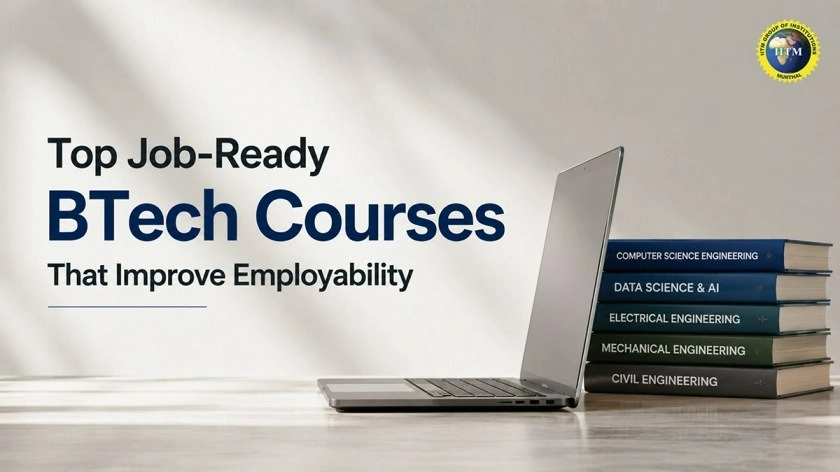
Top Job-Ready BTech Courses That Improve Employability
In 2026, choosing a B.Tech program in Sonipat should start with understanding the skills and experience employers value. Employers increasingly look for graduates who can apply technical knowledge, work with modern tools, solve problems, and adapt to changing technologies. As a result, students are paying closer attention to job-ready B.Tech courses that combine academic learning with the skills employers value. A strong program should offer practical learning, projects, internships, industry exposure, and opportunities to work with emerging technologies. Students should therefore look beyond the degree title and consider how effectively a program prepares them to apply their knowledge in professional settings.
What Makes a BTech Course Job-Ready?
A job-ready engineering program in Sonipat connects classroom learning with the skills students are likely to need beyond graduation. The first factor is an industry-oriented curriculum that keeps pace with developments in technology and professional practices. Subjects should build a strong foundation while also introducing relevant tools, applications and modern engineering approaches.
- Practical learning is equally important. Laboratories, coding exercises, simulations and project-based assignments allow students to move from theoretical understanding to application. Projects can also help students demonstrate problem-solving abilities when building their portfolios.
- Internships provide another valuable layer of experience by exposing students to workplace expectations. Industry interaction through workshops, mentorship, guest sessions and technical events can help students understand how engineering concepts are applied in real organisations.
- Finally, employability involves more than technical knowledge. Communication, teamwork, presentation skills, critical thinking and the ability to explain technical ideas clearly can influence how effectively graduates work in professional environments.
Top Job-Ready B.Tech Courses for 2030
There is no single engineering specialisation that is automatically the right choice for every student. The most suitable option depends on individual interests, strengths and career plans. However, several B.Tech areas offer strong opportunities to develop skills relevant to technology-driven workplaces when supported by practical education.
Computer Science and Engineering remains a broad option for students interested in software development, programming, cloud technologies, cybersecurity and other digital careers. A strong CSE program should provide programming fundamentals alongside databases, operating systems, software development and current technologies.
Artificial Intelligence and Machine Learning is suitable for students interested in intelligent systems, automation and data-driven applications. Relevant coursework can include machine learning, neural networks, deep learning, computer vision and natural language processing. Practical model-building and exposure to real datasets can make the learning more meaningful.
Data Science and Data Analytics can suit students who enjoy working with data, statistics and analytical problem-solving. Students should look for programs that teach programming, data handling, visualisation, statistical concepts and machine learning rather than focusing only on theoretical concepts.
Information Technology can provide a broader technology foundation covering areas such as software, databases, networking, web technologies and information systems. Its value depends significantly on how well the program incorporates current tools and practical projects.
Electronics and Communication Engineering can be relevant for students interested in electronics, embedded systems, communication technologies, automation and hardware-software integration. Hands-on laboratory work is particularly important for building practical understanding in this field.
These specialisations can provide a strong foundation for career preparation, but the degree you choose is only one part of the equation. Job-ready BTech courses should also equip students with relevant technical skills, practical experience and exposure to current industry practices. Ultimately, employability depends on the quality of the program as well as the effort students put into developing their skills beyond the classroom.
Why AI Integration Matters in Modern B.Tech Education
Artificial intelligence is increasingly influencing how organisations develop products, analyse information, automate processes and solve technical problems. As a result, AI literacy can benefit engineering students even when they do not plan to become AI specialists.
An AI-integrated B.Tech curriculum should go beyond teaching students to use popular AI tools. Students should understand concepts such as data, algorithms, automation and machine learning, while learning how AI can be applied to engineering problems.
A useful program may incorporate AI-assisted problem-solving, data-driven decision-making, machine learning fundamentals and AI applications into projects. They should also encourage responsible use of AI, including understanding limitations, accuracy, privacy and human oversight.
The goal is to help engineering students develop practical AI awareness and understand how these technologies can add value within their chosen discipline. This can include using AI for problem-solving, automation, data analysis and engineering applications while building a clear understanding of its capabilities and limitations.
Practical Learning and Industry Exposure
A student’s employability can improve when classroom concepts are repeatedly applied to practical situations. Internships allow students to experience professional workflows, while live projects can require them to define a problem, research possible solutions, develop an approach and present the outcome.
Other useful opportunities include industry visits, workshops, technical competitions, hackathons, industry-led sessions and relevant certifications. These experiences can expose students to tools and situations that may not be fully represented in conventional classroom teaching.
For example, a student studying AI may build a machine-learning project using a real dataset, while a CSE student may develop a working software application. Such projects can strengthen technical understanding while also giving students concrete examples to discuss during interviews.
IITM Sonipat combines core engineering education with practical learning, coding, projects and exposure to emerging technologies across its B.Tech programs. This approach can help students build a stronger understanding of technical concepts while developing skills that are relevant to modern engineering roles.
Choosing the Right B.Tech College in Sonipat
Choosing an engineering college in Haryana, Sonipat involves more than comparing rankings or reputation. Students should consider factors such as approvals and affiliations, curriculum, faculty expertise, laboratories, infrastructure and opportunities for practical learning. Industry exposure also matters, so it is worth checking for internships, live projects, workshops and interactions with professionals.
Fees should be considered alongside the overall academic value, facilities and learning opportunities. At IITM Sonipat, students can explore B.Tech programs that combine academic learning with practical training and exposure to emerging technologies. Reviewing the programme structure, facilities and opportunities available can help students understand whether the college fits their academic and career goals.
Ultimately, the right institution depends on a student’s preferred specialisation, budget, learning priorities and career plans. Comparing these factors can help students make a more informed choice when selecting a private college in Haryana.
How to Choose a Job-Ready BTech Programme
Students can use a simple checklist before finalising their engineering programme:
- Check the curriculum: Look for strong engineering fundamentals combined with relevant technologies.
- Compare specialisations: Consider your interests, strengths and intended career direction.
- Look for practical learning: Review laboratories, projects, coding practice and applied assignments.
- Evaluate industry exposure: Check for internships, mentorship, workshops and live projects.
- Check AI and emerging-technology integration: Determine whether these are genuinely incorporated into learning.
- Consider internships and projects: Prioritise programs that help you build demonstrable experience.
- Review career support: Examine training, interview preparation and other career-development initiatives.
- Compare fees and overall value: Consider the complete learning experience rather than tuition cost alone.
This approach can help students distinguish between programs that simply offer an engineering degree and Job Ready BTech Courses that actively develop technical, practical and transferable skills.
Build Employability Beyond the Degree
Selecting a B.Tech specialisation is only the starting point of career preparation. Job-ready BTech courses can provide a strong foundation when they combine relevant technical knowledge with practical projects, internships, AI and emerging-technology exposure, industry interaction and communication skills. However, employability also depends on how actively students build their capabilities through projects, certifications, competitions, internships and continuous learning. By comparing curriculum quality, practical exposure, industry relevance, career support and overall value, students can choose a B.Tech program that better matches their individual goals and prepares them to adapt to changing professional requirements.
FAQs
An AI-integrated B.Tech program incorporates artificial intelligence into engineering education through relevant subjects, practical projects, AI tools, data-driven applications, and emerging-technology learning. The exact level of integration depends on the curriculum and specialisation.
There is no universally applicable answer as to which is the best BTech college in Sonipat. Students should compare approval and affiliation, curriculum, faculty, infrastructure, practical exposure, industry interaction, career support and fees before making a decision.
Computer Science Engineering, Artificial Intelligence and Machine Learning, Data Science, Information Technology and Electronics and Communication Engineering can offer relevant career preparation when supported by strong fundamentals, practical learning, projects and industry exposure.
B.Tech admission generally involves checking eligibility, completing the application, submitting documents and following the college’s selection process. Requirements may vary by program. For IITM Sonipat, students can check the official website for current 2026–27 admission details.
A new-age BTech program typically combines core engineering education with emerging technologies such as AI, practical projects, industry exposure and career-focused skill development. Affordability should be assessed alongside curriculum quality, facilities, internships, industry exposure and the overall value provided by the program.

I am Dr. Sunil Nijhawan, Principal and Head of the Departments of Electrical Engineering and Electronics & Communication Engineering. With over 25 years of academic experience, I am committed to delivering quality technical education through innovation, research, and industry-oriented learning. My focus is on developing technically proficient, ethically responsible, and future-ready engineers by fostering academic excellence, practical exposure, and a culture of continuous learning.